
Gallium nitride (GaN) transistors are transforming power electronics thanks to their ability to switch, that is, to turn on and off extremely quickly while minimizing energy losses. These characteristics make them ideal candidates for demanding applications, ranging from robotic systems to high-precision electric drives. However, this speed also introduces new challenges.
Researchers at Riga Technical University, Kaspars Kroičs and Jānis Voitkāns, have developed a strategy to reduce the overvoltages that occur when an electronic inverter, the device responsible for supplying and regulating the power delivered to a motor, uses GaN technology and is connected through long cables.
Their work, published in the journal Electronics, combines experimental measurements, models that reproduce the electrical behaviour of the system at high frequencies, and the design of a new filtering solution. The result: voltage spikes that reached 80% above the expected value were reduced to below 10%.
These findings contribute to the development of more reliable and efficient drive systems, a key technology for advanced industrial applications, robotics, and other fields that require high-performance electric motors.
The challenge: when electrical signals bounce back, overvoltages arise
The focus of the study is on permanent magnet synchronous motors used in industrial and robotic applications. These motors are powered through electronic inverters that generate high-frequency electrical signals.
GaN transistors allow these signals to change state extremely rapidly. While this improves system efficiency, it also creates a less intuitive phenomenon: electrical signals can behave like small echoes travelling along the cable connecting the inverter and the motor. It is similar to what happens when a person shouts in the mountains and the sound bounces back as an echo.
These reflections occur because the cable and the motor have different electrical characteristics, a phenomenon known as impedance mismatch. As a result, part of the signal sent by the inverter is reflected when it reaches the motor and then continues to bounce back and forth between both ends of the system. When the cable is sufficiently long and voltage transitions are very fast, these reflections can add up and generate significant overvoltages at the motor terminals.
In addition to stressing the motor’s electrical insulation, these overvoltages can shorten the lifespan of certain components and increase problems associated with parasitic currents.
The solution: modelling the system to design a more effective filter
To better understand this phenomenon, the researchers built an experimental inverter prototype based on GaN transistors and connected it to a motor through a 33-metre-long cable.They then measured the electrical response of both the cable and the motor across a wide frequency range. These data allowed them to create models capable of accurately reproducing the system’s real behaviour and predicting the occurrence of overvoltages.
In a sense, the researchers created an “acoustic map” of the electrical system: before eliminating the echoes, they first needed to understand where they originated, how they travelled, and how strongly they returned.
The team evaluated several strategies to reduce these voltage spikes:
- Reducing the switching speed of the transistors, thereby lowering the rate at which voltage changes.
- Using an actively controlled LC filter capable of smoothing the signal through additional electronic components and a dedicated control strategy.
- Employing passive RL filters based on a combination of resistance and inductance (a coil).
- Using passive RC filters composed of a resistor and a capacitor.
- Combining RL and RC filters distributed between the inverter and the motor.
The results showed that none of the individual solutions was entirely satisfactory. Reducing the switching speed helped dampen the electrical echoes, but it also diminished some of the advantages offered by GaN technology. Active filters performed well, although they increased the system’s complexity. Meanwhile, standalone RL or RC filters reduced the overvoltages only partially and could not eliminate them effectively.
The most effective solution was to combine passive filters at both ends of the cable. On the inverter side, the researchers installed an RL filter consisting of a resistor and an inductor, while on the motor side they placed an RC filter composed of a resistor and a capacitor.
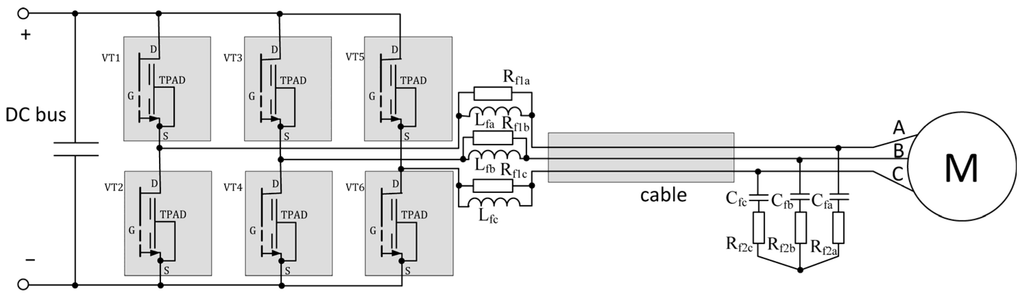
Working together, these filters act as dampers for the reflected electrical waves. Much like acoustic panels reduce reverberation in a concert hall, this filtering system attenuates electrical echoes before they can build up and produce dangerous voltage peaks.
Experimental tests showed that the overvoltage could be reduced from values close to 80% to approximately 10%, with power losses below 10 W at a switching frequency of 50 kHz.
What comes next?
As wide-bandgap devices such as GaN transistors become increasingly common in industrial systems, managing overvoltages will become an ever more important challenge.
The authors emphasise that accurate models of both the motor and the cable will be essential for designing increasingly efficient filters. Although high-frequency electrical models can become highly complex, the study demonstrates that even simplified approaches can predict system behaviour with sufficient accuracy and help optimise mitigation strategies.
In addition, according to the authors, passive filters will continue to play an important role, although there is still room for optimisation. One of the most promising directions is the development of automated methods capable of simplifying complex electrical models of motors and cables while selecting filter components more effectively.
In a way, the future goal will be to “listen” more carefully to these electrical echoes in order to neutralise them more efficiently. As GaN technology expands into fields such as advanced robotics, industrial automation, and high-efficiency energy systems, controlling these reflections will become increasingly important for ensuring the reliability and durability of the next generation of electric motors.